

This year, you’ll notice the same thing absent from practically every virtual classroom session: no one is staring at a static slide presentation. They are seeing a sticky note appear, a cursor move, and a diagram being recreated in real time by a student who is three time zones away. Even though it may seem insignificant, that change has subtly changed how instruction takes place on a screen.
It’s simple to overlook how recent all of this is. For many years, the actual whiteboard was just wall-mounted furniture that was mostly used by the instructor in front of it. Nearly instantly, remote learning disrupted that paradigm, and software developers hurried to fill the void with something more akin to a shared surface than a video conversation. The outcomes have been inconsistent, sometimes awkward, but getting harder to ignore.
Early on, Google’s Jamboard was a favorite, and teacher forums continue to discuss its closure last year with a hint of nostalgia. Although it wasn’t the most effective tool, its simplicity was important to overburdened instructors who already had to manage six other platforms. Competitors quickly filled the void left by its removal, each wagering that classrooms could handle a little more complexity provided it came with improved collaboration.
Miro has emerged as the go-to solution for that wager, particularly in hybrid environments where both in-person and remote learners must simultaneously touch the same board. Its origins are in corporate brainstorming sessions, therefore it wasn’t initially intended for educational settings. However, its business-first design worked surprisingly well for group projects and language lessons, where visual thinking is just as important as word. One may argue that education adopted this tool rather than the other way around. This is evident in subtle ways, such as templates that are obviously intended for sprint planning rather than spelling sessions.
The shift toward infinite canvases is what’s happening right now, and it’s happening more quickly than most people outside of EdTech circles realize. Students were compelled to think on slides by fixed-page whiteboards. An unlimited one allows a lesson to spread out like a real conversation, veering off course when a question comes up. Teachers who have tried both typically characterize the difference more in terms of classroom energy, such as students being focused for longer periods of time and ideas building on one another rather than being interrupted at page breaks, than in technical terms.
There is friction in all of this. Schools with diverse device fleets frequently have to make feature compromises in order to keep everyone synchronizing at the same speed, while foldables and mid-range Android tablets still struggle with some of the heavier apps. The amount of student data that these programs covertly gather during “real-time collaboration” is another more subdued worry among IT managers that hasn’t received nearly as much attention as it most likely merits.
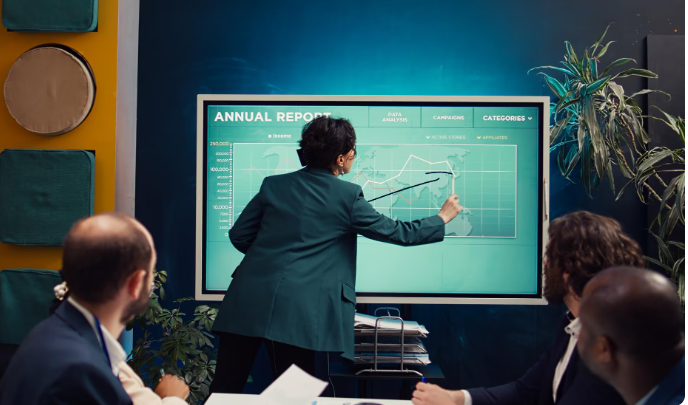
Nevertheless, it’s difficult to ignore how commonplace everything has become in such a brief period of time. Alongside the projector and the login information for the learning management system, a gadget that hardly existed in classrooms a few years ago is now considered critical infrastructure. It’s actually unclear if the present leaders—Miro, Microsoft Whiteboard, and the smaller competitors vying for their market share—will continue to dominate. The blank board that is posted on the wall doesn’t appear to be returning as the focal point of the space.
